
Risk, Reined In: Smarter Contracts for Financial Services
Smart contracts for BFSI reduce risk, strengthen compliance, and improve vendor governance. Learn how smarter contracting protects financial institutions.

Financial services don’t just operate on capital, liquidity, and trust. They operate on contracts. Every vendor agreement, partnership, outsourcing deal, or cloud subscription is underpinned by obligations and rights captured in legal documents. These contracts dictate how risk is shared, how data is handled, and how disputes are resolved.
Yet, in practice, weak contracting has become a silent liability for banks, insurers, fintechs, and NBFCs. Unlike market risks, which erupt in the form of bad loans or liquidity shocks, contractual risks creep in quietly through missed renewals, vague clauses, or inadequate compliance terms. By the time they surface, the damage is often financial, reputational, and regulatory.
This blog explores where risks emerge in financial contracts, why smarter contracts are now indispensable, what defines a “smart contract” in this context, and how adopting them benefits BFSI institutions.
The Hidden Risks in Financial Services Contracts
1. Fragmentation and Visibility Gaps
In many institutions, contracts are scattered across departments, buried in emails, or locked in unsearchable PDFs. This fragmentation leads to blind spots: teams may not know which SLAs apply, when renewals are due, or whether regulatory requirements are embedded. As a result, obligations slip and disputes arise.
2. Outdated or Incomplete Clauses
Many financial institutions still rely on legacy templates, some written before digital-first banking, cloud outsourcing, or data protection norms like India’s DPDP Act. These documents rarely reflect current obligations such as data localization, breach notification, or outsourcing transparency. Outdated clauses create regulatory non-compliance by default.
3. Manual Approvals and Exceptions
Contracts often bypass governance when rushed. Maker–checker principles are ignored, exceptions get signed off informally, and deviations from standard terms pile up. Without clear approval trails, it becomes difficult to prove accountability in case of disputes or regulatory audits.
4. Regulatory Complexity
The financial sector is heavily regulated: outsourcing guidelines from the RBI, data processing rules under DPDP, cybersecurity frameworks, and global expectations like GDPR or PCI DSS. Each requires explicit contractual safeguards such as audit rights, incident timelines, and sub-processor disclosures. Weak contracts risk direct penalties as well as reputational fallout.
5. Vendor and Third-Party Dependencies
From KYC partners to payment processors, BFSI institutions depend on hundreds of third parties. Each adds operational and compliance risks. Contracts that fail to clearly define SLAs, security controls, liability, or exit assistance leave institutions exposed when things go wrong.
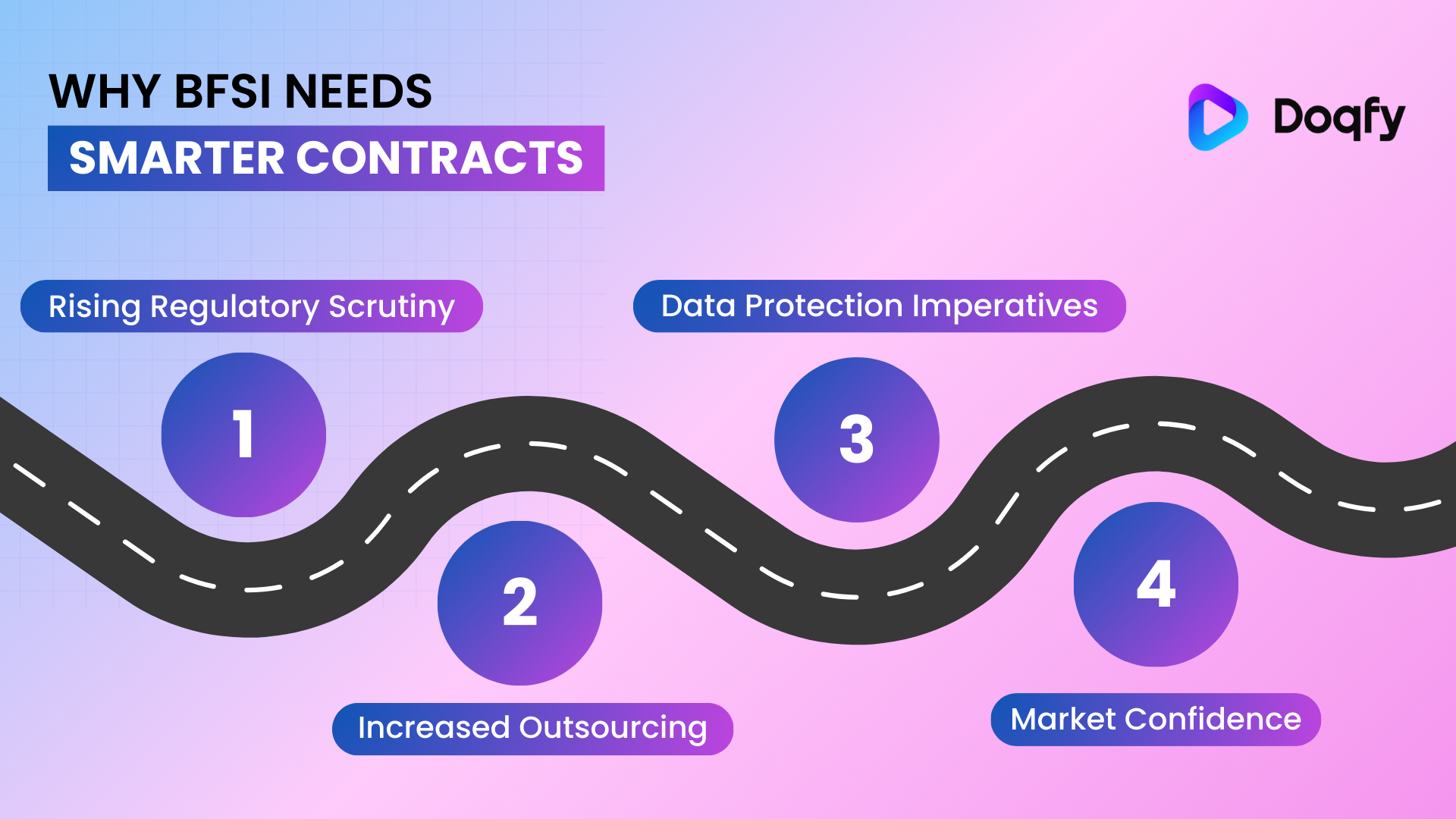
Why BFSI Needs Smarter Contracts Now
Historically, contracts were treated as static paperwork: negotiated once and filed away. But in the digital-first financial sector, contracts must act as living governance frameworks.
Rising Regulatory Scrutiny
Regulators increasingly demand evidence of contract enforcement, not just contract existence. Institutions must show that clauses are applied, obligations tracked, and deviations approved.
Increased Outsourcing
From IT and cybersecurity to collections and payments, outsourcing is accelerating. Each relationship magnifies risk unless managed through robust, transparent contracts.
Data Protection Imperatives
With DPDP and similar regulations, contracts are the front line of compliance. Without data processing and breach clauses, even a minor incident can escalate into a legal and financial crisis.
Market Confidence
Investors, boards, and customers expect institutions to demonstrate resilience. Smarter contracts are tools of accountability, protecting both reputation and balance sheets.
In short, BFSI cannot afford “paper contracts.” They need contracts that actively govern risk.
The Anatomy of Smarter Contracts
What does a smarter contract look like in the financial services context? It is not about blockchain-based “smart contracts,” but rather about intelligently structured, technology-enabled agreements.
A Single System of Record
All contracts stored in a central repository, searchable and accessible with role-based permissions. Version histories and audit trails ensure accountability for every change.
Role-Based Governance
Maker–checker workflows, approval matrices, and deal-size thresholds ensure no unauthorized deviations slip through. Contracts align to organizational risk appetite.
Standard Clause Libraries
Pre-approved templates cover recurring issues: SLAs, data handling, information security, liability, outsourcing, termination, and audit rights. This ensures consistency and reduces negotiation risk.
Operationalized Obligations
Each clause maps to an owner, deadline, and alert. Obligations are no longer buried in text; they are actionable tasks visible in dashboards.
Tamper-Evident Execution
E-signatures with timestamps and certificate chains provide defensible proof of execution. Activity logs show who signed, when, and under what terms.
Integration with Policy and Regulation
Clause libraries and workflows are updated as regulations evolve: DPDP, RBI outsourcing rules and SEBI disclosures, ensuring compliance stays current.
Analytics and Reporting
Institutions gain insights into contract cycles, deviation rates, SLA breaches, and renewal risks. This enables proactive risk management rather than reactive firefighting.
Benefits of Smarter Contracts in BFSI
Reduced Disputes and Costs
Well-structured contracts minimize ambiguities, reducing litigation and vendor disputes
Stronger Compliance
Contracts embed regulatory requirements, making audits smoother and minimizing penalties
Clear Accountability
Obligation-to-owner mapping ensures nothing falls through the cracks. Everyone knows who owns what, by when
Audit-Readiness
Defensible evidence like signatures, approval trails and activity logs reduces audit preparation time and regulator scrutiny
Efficiency and Agility
Cycle times shorten as templates, approvals, and e-signs cut paperwork delays. This agility is crucial in a competitive market
Enhanced Vendor Management
Contracts set measurable standards for third parties, with penalties for underperformance and clarity on termination or exit
Practical Scenarios in BFSI
Lending & Collections
Agencies engaged for recovery must adhere to fair-practice clauses, data privacy requirements, and dispute timelines. Weak contracts risk regulatory action and reputational harm.
Payments & Fintech Partnerships
Contracts must specify uptime SLAs, incident timelines, and chargeback handling. Without this, institutions face operational disruption and financial liabilities.
Cloud & IT Outsourcing
Data residency, privileged access, audit rights, and exit assistance clauses ensure resilience. Absent these, institutions risk lock-in or data breaches.
Insurance
Contracts with TPAs and vendors must capture claims timelines, fraud detection measures, and compliance with grievance redressal norms.
Implementing Smarter Contracts: A Roadmap
Centralize Contracts
Bring every agreement into a unified repository
Standardize Clauses
Use tested clause libraries for consistency and risk control
Map Obligations
Assign owners and automate reminders for renewals, certifications, and reports
Automate Workflows
Introduce digital approvals, maker-checker controls, and tamper-evident e-signatures
Monitor & Review
Use dashboards to track contract health, deviations, and compliance readiness
Update Regularly
Refresh templates and libraries in response to regulatory or market changes
Doqfy: Enabling Smarter Contracts for BFSI
Doqfy transforms contracts from static documents into active governance tools.
It unifies draft → review → approve → e-sign → obligation tracking in one secure platform. Key capabilities include:
- A central repository with audit-ready trails
- Pre-approved clause libraries aligned to BFSI compliance norms
- Maker–checker workflows and approval matrices
- Obligation dashboards with automated alerts
- Tamper-evident e-signatures ensuring defensibility
- Analytics and reporting for cycle time, deviations, and risk monitoring
For BFSI leaders, Doqfy ensures contracts are not weak links but strategic assets protecting compliance, speeding execution, and strengthening trust.
Conclusion
To sum up, risk doesn’t just emerge in credit portfolios or markets in financial services; it begins in the fine print. A missed SLA, an outdated clause, or a lost renewal can cascade into reputational damage and regulatory fines.
Smarter contracts are no longer optional. They are essential infrastructure for BFSI resilience. By embedding governance into contracts, institutions turn risk into managed exposure and compliance into capability.
Doqfy enables this shift by helping banks, insurers and fintechs rein in risk through smarter, stronger contracts. Book a demo to explore it firsthand.
References:
- Company officials booked for providing fake bank guarantees in Ujjain water pipeline contract | Indore News - The Times of India
- Manesar MC slaps Rs 9-crore penalty on sanitation contractor over irregularities - The Tribune
- Byju’s Financial Crisis Unveiled: Understanding the Complex Web of Lawsuits and Bankruptcy Filings