
Make in India, Manage in India: Weak Contract Infrastructure Holds Back Local Manufacturing
Explore the contract gaps holding Make in India back, and how platforms like Doqfy can help bridge the execution divide for local manufacturing with stronger contracts.


Launched in 2014, the Make in India campaign aimed to turn India into a global manufacturing powerhouse.
Over a decade later, despite significant strides, manufacturing’s share of GDP remains below 18%, far from its 25% target.
Growth is stunted by infrastructure gaps, complex regulations, and supply chain inefficiencies. While factories rise, execution often falters where contracts fall short.
Central to this execution gap is contract infrastructure: Drafting, negotiating, governing, and enforcing agreements that underpin core aspects such as land allocation, equipment procurement, vendor management, and compliance with incentive schemes. Weakly drafted or poorly tracked contracts don’t just delay investments, but they can also erode trust, stall incentives, and break momentum.
Manufacturing Aspirations vs. Ground Realities
India’s manufacturing journey is rich with ambition, yet riddled with practical hurdles: patchy infrastructure, fragmented regulations, and uneven execution. Despite initiatives to improve connectivity and production frameworks, execution fails when contracts don’t align with reality.
Example: Plug-and-play industrial zones promise fast execution but stall when agreements don’t fix timelines or penalties for delays.
Without stronger contract fundamentals, the Manufacturing Mission 2025-26, which aims to enhance MSME access, ease of doing business, and competitiveness, under-delivers.
The Hidden Curve: Where Contracts Derail Manufacturing
Consider the typical manufacturing project: land allotment, utilities, equipment delivery, vendor assembly, supply chain setup. Each node depends on contracts often pushed through under pressure, sometimes with corners cut.
Delayed Projects
A notable case involved an electronics facility where the supplier rushed into a long-term lease without clauses for demand volatility. Two years later, volumes dropped and lease costs became a liability. A strategic partnership with a logistics provider would have offered flexibility.
Regulatory Overhangs
Indian contract manufacturing firms face red tape for land acquisition, licensing, and labor compliance. These are delays that are often unaccounted for in agreements.
Fragmented Supply Chains
Missing quality clauses for local vendors lead to inconsistent inputs and unexpected delays. Without fallback terms, disruptions cascade.
Such hurdles ripple through execution, disincentivizing scale and dissuading both domestic and foreign players.
What Better Contracts Look Like for Indian Manufacturing
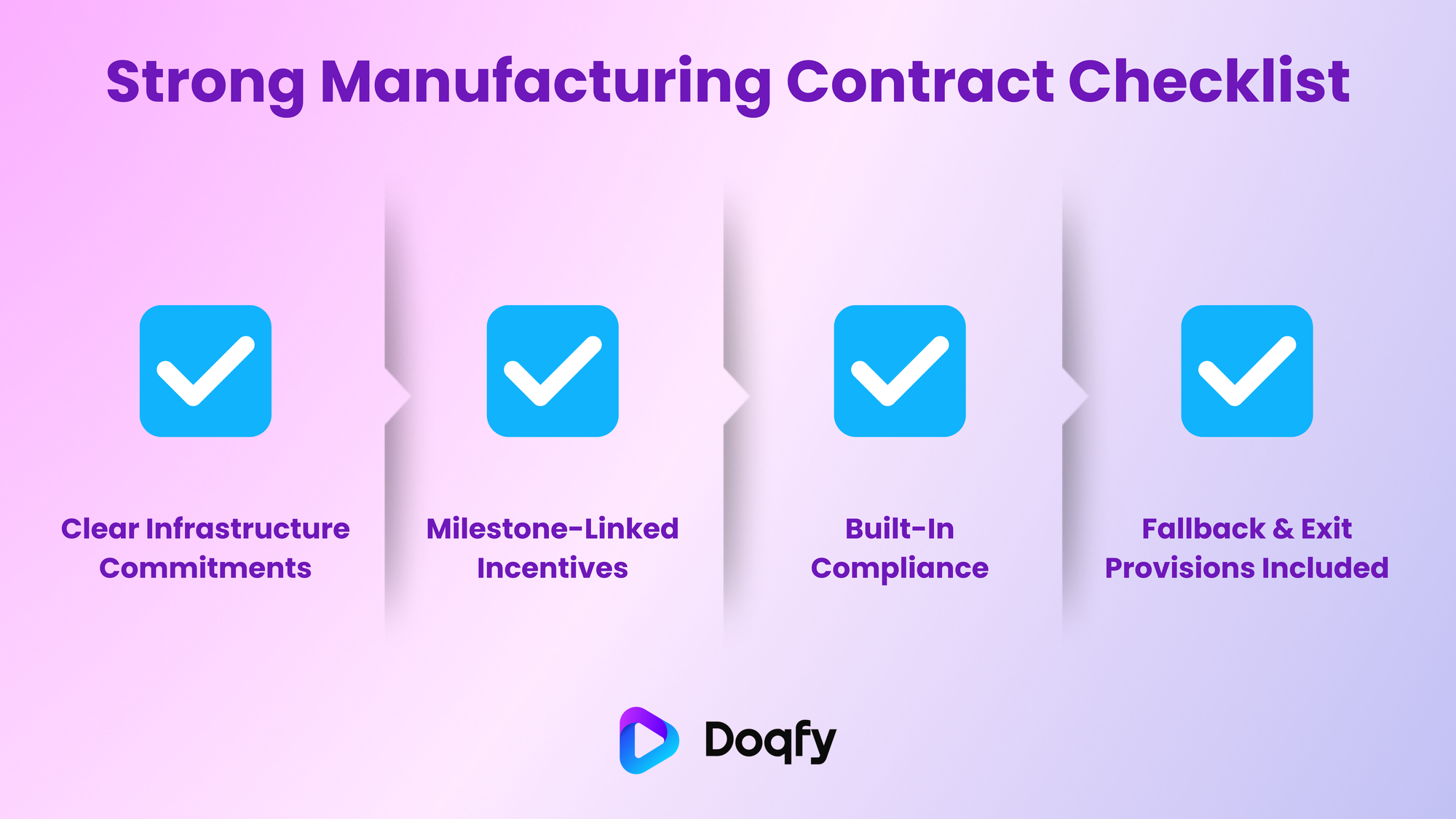
Smarter contracts for manufacturing don’t just document terms; they govern outcomes. They embed clarity, incentivize action, and manage risk.
Infrastructure Commitments
Contracts must specify concrete timelines for land availability, power connections, road access, and logistics support.
Milestone-Linked Incentives
Schemes like PLI (Production Linked Incentive) offer rewards tied to production benchmarks. Contracts must reflect these linkages and stipulate validation mechanisms.
Built-in Compliance
Local manufacturing mandates (Atmanirbhar Bharat), skill development, and content localization should be contractually enshrined with penalties for deviation.
Fallback and Exit Provisions
Manufacturing timelines rarely hold. Contracts need buffer mechanisms, like grace periods, penalty caps, and exit clauses to manage operational risks.
These constructs transform contracts from legal formality to management instruments.
Why Smarter Contracts Matter: The Payoff
When contracts are designed to manage risk, benefits are tangible:
Reduced Disputes and Delays
With clear SLAs and fallback terms, arbitration reduces and execution accelerates
Faster Incentive Capture
Milestone clarity speeds access to PLI rewards and other subsidies
Resilient Supply Chains
Contracted quality and delivery terms drive vendor reliability
Policy Alignment
Enforcement of sourcing and compliance requirements ensures alignment with national ambitions
Investor Confidence
Transparent, tested contracts reassure domestic and global players
In zones like UP’s electronics clusters and Odisha’s new manufacturing policies, contract clarity could unlock full potential.
Enabling Smart Contracts: The Role of Platforms Like Doqfy
Given the complexity of manufacturing contracts, digital-first contract management isn’t an option, it’s essential.
Doqfy streamlines the entire lifecycle
- Central repository with version control and role-based access
- Pre-built clause libraries for infrastructure, incentives, compliance, and exit management
- Tracking modules for milestones, reviews, and deliverables
- Alerts for delays, renewals, or missed obligations
- eKYC/eKYB and Auth Gateways for Aadhaar, GST, and PAN-based verification
- eSign and eStamp facilitation
- Audit-ready execution logs and approval history
With Doqfy, contracts become living infrastructure, anchoring local manufacturing to precision, transparency, and accountability. It also helps “Made in India” become “Managed in India”.
Conclusion
Summing up, India’s manufacturing ambitions have admirable vision. But they also have too many execution gaps, many of which stem from outdated, reactive contracting practices.
To accelerate the Make in India journey, manufacturing leaders need need systems that drive accountability, enable precision, and safeguard operational timelines within their operations.
With digital-first platforms like Doqfy, contracts stop being a hurdle and start becoming a catalyst. Explore how Doqfy’s end-to-end contract lifecycle management strengthens
References
- Reflecting on a Decade of Make in India: Achievements, Challenges, and the Road Ahead | KPMG
- Challenges of Make in India | DRIIV
- Contract Manufacturing in India: Sectors, Costs & Guide | Pulraj
- Manufacturing in India: Opportunities and Challenges | Dimerco
- The Manufacturing Mission (2025-26): Furthering ‘Make In India’ - IMPRI Impact And Policy Research Institute
- Synergising National Infrastructure Pipeline and Make in India: Roadmap for economic transformation and manufacturing growth | Economic Times
- Atmanirbhar Bharat | Wikipedia