
Contracts vs. Compliance under DPDPA: The Clauses Your Agreements Need
DPDPA compliance relies on contracts, not just policy. See the clauses to add in MSAs, DPAs, & vendor agreements, & how Doqfy helps the entire process from draft to approval.

India’s Digital Personal Data Protection Rules 2025 (DPDPA) give organisations a clear pathway to handle personal data with purpose, consent, security, and accountability. Turning that pathway into day-to-day practice starts with contracts.
When MSAs, DPAs, and vendor agreements contain precise roles, timelines, and evidence requirements, you can deliver consistently, audits run faster, and leadership can see progress in one place.
India has now notified the DPDPA, which means breach clocks, cross-border checks, and documentation standards should be reflected in operational agreements, not only in policy handbooks.
Key Contract Clauses for DPDP
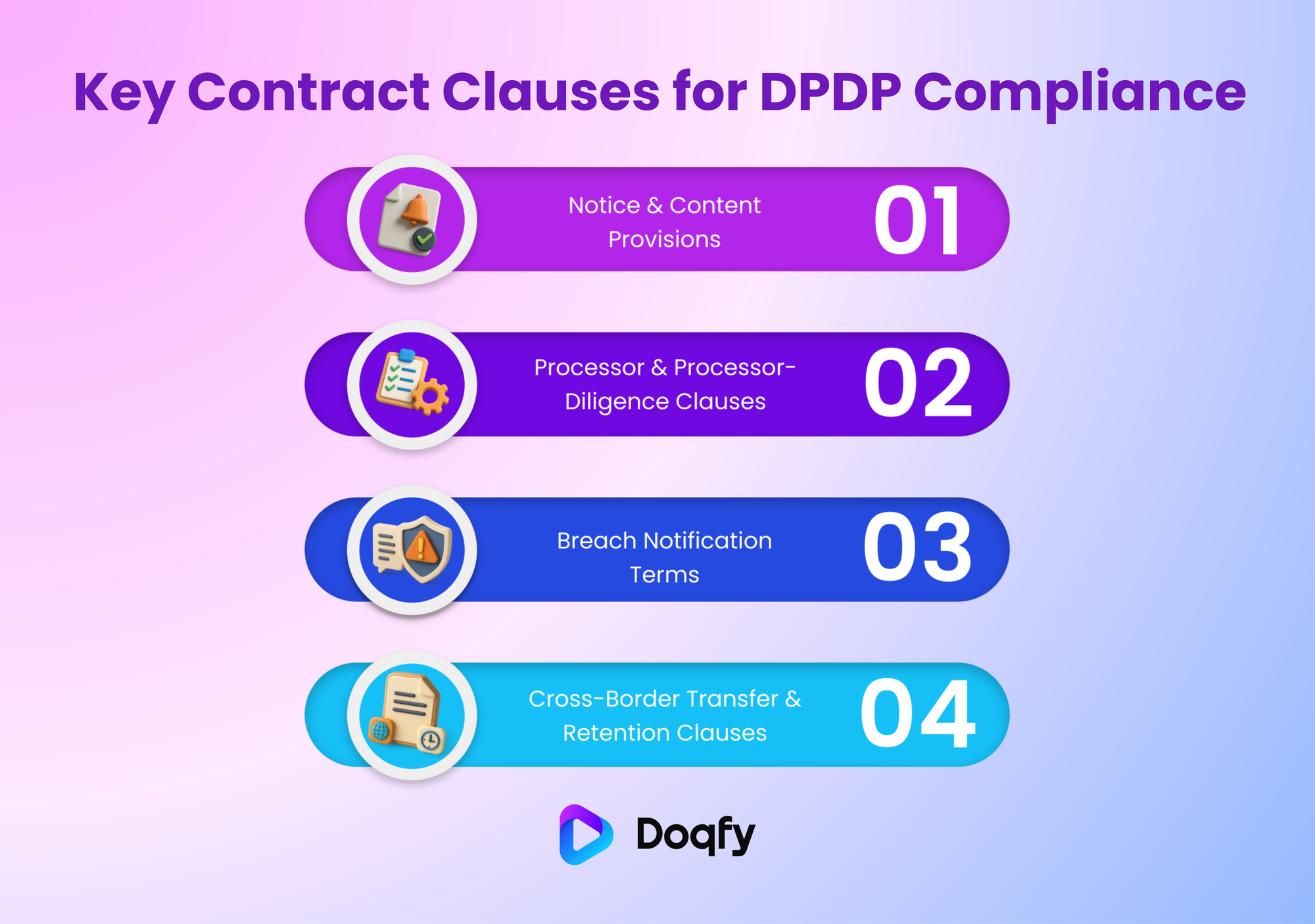
To align with the DPDP Rules 2025 and reduce legal exposure, your contracts should make roles, timelines, and evidence requirements explicit. The Rules were notified on 13 November 2025.
Notice and Consent Provisions
- Spell out who controls which data, for what purposes, and where the purpose is recorded in SoWs or order forms.
- Set out when consent is required, how it is obtained, how withdrawal works, and how proof is stored so it can be produced during reviews.
- Keep the language consistent with public privacy notices to prevent purpose drift and to support audits.
Processor & Processor-Diligence Clauses
- Require processors and sub-processors to follow security standards, cooperate with audits, support data subject requests, and delete or return data on exit with proof.
- Include a sub-processor approval process, a registry with locations and services, and clear remediation timelines if gaps are found.
- These terms convert third-party risk into obligations that can be measured and verified.
Breach Notification Terms
- The Rules require notification to the Data Protection Board within 72 hours of awareness, with timely notice to affected individuals.
- Translate this into contract text by defining awareness, setting internal triage steps and client notice deadlines, listing required artefacts, and requiring post-incident reviews and retest rights for critical workloads.
Cross-Border Transfer & Retention Clauses
- Section 16 creates a negative list model: transfers are allowed except to jurisdictions later restricted by the government.
- Contracts should require destination checks before transfer and when support locations change, documentation of safeguards for allowed destinations, and a reassessment process if a country becomes restricted.
- Pair with data minimisation, defined retention, and verifiable deletion, including certificates on exit and timelines for backup deletion where feasible.
Why Contract Language Matters for DPDP Compliance
According to PwC India, only 16% of consumers understand the DPDPA, and many organisations anticipate implementation challenges.
Clear contract language lowers the chance of missteps and provides evidence when questions arise. When drafting, it’s important to keep the following factors in mind:
- Policies are not substitutes for obligations: Investigations look for enforceable terms and evidence, not intent statements
- Roles and accountability must be explicit: Controller and processor duties, approval rights, and evidence requirements prevent ambiguity during reviews
- Timelines need contractual clocks: Without breach and deletion timelines in contracts, teams struggle to meet regulatory expectations
- Vendor behaviour is shaped by contracts: Audit rights, sub-processor controls, and service credits give practical levers to improve outcomes
- Trust depends on proof: Deletion certificates, consent logs, audit reports, and incident records show that commitments were met
How to Build DPDP-Compliant Contracts
Doqfy is built for making contracts compliance-ready. It provides the tools you need to build contracts that align with DPDP requirements from the first draft to execution:
- Clause Libraries: Preloaded language for notice and consent, processor duties, breach timelines, retention, and cross-border controls, selectable by scenario and jurisdiction
- Templates: MSA, DPA, and vendor templates that anchor SoWs to purpose statements and role definitions, preventing essential clauses from being missed
- Execution Workflows: Version history, role-based approvals, and audit logs that record who approved which change and why
- Alerts And Trackers: Reminders for processor renewals, breach notice clocks, transfer checks, and expiring attestations
- Dashboards: Coverage by clause, sub-processor locations, audit status, and incident timeline performance, so exposure and progress are visible at a glance
Conclusion
Summing up, DPDPA sets duties that should live inside contracts teams actually use.
Start with the agreements that handle personal data, record purpose where work is scoped, assign roles and transfer checks in the privacy annex, set incident timelines that meet the rules, and require deletion that can be evidenced.
With Doqfy, these steps are standardised across documents, enforced through approvals and alerts, and supported by records that stand up to review. The result is fewer gaps, clearer accountability, and a compliance posture that is easier to defend.
With contracts done right, you move from risk exposure to defensible compliance.
References:
- Digital Personal Data Protection Act, 2023 DPDPA SECTION 16 WITH INTERPRETATION
- Only 16% consumers in India understand the Digital Personal Data Protection (DPDP) Act: PwC India survey
- Avg data breach cost hit Rs 19 cr in 2024; 16% Indians know privacy rights | Personal Finance - Business Standard
- Data protection laws in India
- MeitY notifies final Digital Personal Data Protection Rules 2025
- Data Breach Reporting Timeline of DPDP Rules 2025 Explained